
Life on a Shoestring: Embracing Grit and Grace Through Adversity
- Jul 4, 2025
- 10 min read
Updated: Jan 1

HOOKS…GUNS AND GOD!
The salt-spray air of San Diego clung to us as we piled into the camper, a family bound for adventure. I was the youngest by nine years, a wide-eyed tagalong in a boisterous Italian clan where love was loud and life was full. We weren’t devout Catholics then—not in the way I’d later come to know God—but faith was a quiet undercurrent, like the tide pulling at the shores where we fished and surfed. My childhood was a tapestry of water and wilderness, woven with crab tacos at San Miguel, clamming near the San Onofre Power Plant, and bonfires on the bay where my cousins and I ran wild, barefoot and free.
Every October, when Halloween loomed, my parents pulled us from school for two weeks of what I now call sacred chaos. We’d load the camper with fishing rods, rifles, a shotgun, and enough provisions to survive a frontier winter. Our destination: Utah, a land of jagged roads and endless skies. We’d stop in Las Vegas, where Dad, a gambler with a glint in his eye, would roll the dice and register for the “Biggest Deer” contest. Then, singing off-key to Johnny Cash, we’d rumble into Beaver, Utah, to a campground called Cove Fort, marked by a lone Chevron sign glowing like a beacon.
Our campsite nestled in a valley below a small hill, where Dad strung a swing from towering trees. I’d soar over a babbling creek, its water so clear I called it “magic.” We drank straight from it, cupping our hands without a thought of giardia or deer droppings. That water was pure, like my heart when I was outdoors—a gift from God I didn’t yet name but felt in every fiber. At night, Mom heated creek water for “spit baths,” as she called them, scrubbing us clean with a washcloth in the camper’s glow, the stove’s three burners chasing away the October chill. One morning, I woke to icicles dangling from the skylights. Dad, ever resourceful, warmed bricks to tuck at my feet, keeping me snug in my Redwing boots and wool socks.
Mornings began before dawn. Mom, Austrian and precise, whipped up bacon and eggs for Dad’s hunting trips, packing him a sandwich for the trail. I’d drift back to sleep, then wake to her polichinken—crepes dusted with powdered sugar and filled with homemade jam, a taste so divine it still lingers as the pinnacle of my childhood. Dad, though, was no culinary artist. His deer, hung to age in the trees, became tough, gamy meals we choked down with forced grins. His duck dishes, studded with shotgun BBs, were even worse.
After deer season, we’d head north to a game preserve near Fillmore. I’d huddle with Dad in the blinds, marveling as he dropped two ducks with one shot. To me, he was a giant—6’5” of grit and gruff, fearless in my young eyes. There, we befriended a Mormon game warden and his wife, whose warm home overflowed with quilts and baked goods. I learned to stitch patches under their guidance, my small hands fumbling with thread, my heart soaking up their kindness.
One year, we ventured farther north to Bear Lake, straddling Utah and Idaho. With Dad’s friend Jim, a San Diego lawyer, we camped on a barren hill—no trees, no sagebrush, just vast emptiness. As we picked BBs from a dubious duck-and-tomato-sauce dinner, a sharp knock rattled the camper door. Dad opened it to nothing but darkness. His face, usually unshakeable, flickered with unease. We left at dawn, the mystery unanswered, a ghost story etched in my memory.
Fishing was our joy. At a sprawling lake, we cast for pan-sized trout, their bellies stuffed with canned corn. Dad, never one for limits, ensured we hauled in more than our share. Our dachshund, Gus, once mistook a treble hook for dinner, swallowing it whole. While I fretted, Mom and Dad calmly took him to a vet, who assured us the hook would dissolve. I became Gus’s nursemaid, hovering over him as we fished, my love for the outdoors deepening with every cast.
The air in Utah was crisp, scented with golden quaking aspens—a smell that still carries me back to those pure, untamed days. Hooks, guns, and the quiet stirrings of God wove through it all: the tug of a fish on the line, the crack of a rifle, the sense of something bigger watching over us. Those trips shaped me, grounding me in the wild, where my heart still runs free.
ECHOS OF THE WILD
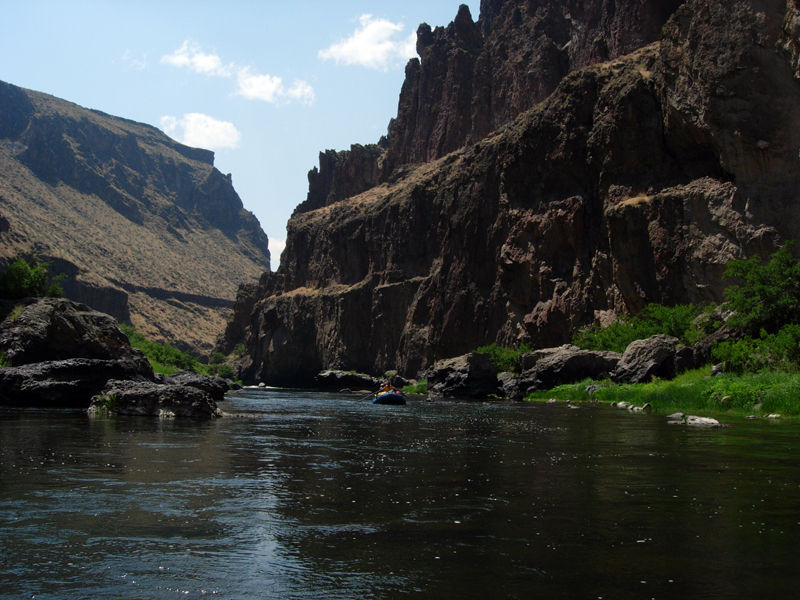
The Owyhee River carved its way through a land older than memory, where Mahogany Mountain stood guard, its caldera silent for 15.5 million years. Rhyolite cliffs and tuff formations, born from ancient eruptions, loomed over the Leslie Gulch, whispering of a time when fire shaped the earth. This was no gentle country. The sun scorched the sagebrush in summer, and winter’s chill could freeze your breath. Sparse junipers clung to life amid the dust, while antelope ghosted across the plains. The river, once a haven for Native American fishermen and campers, now called to adventurers like us—fools, some might say—chasing its Class III and IV rapids and the promise of smallmouth bass.
I was 48, still raw from a hip replacement that clipped my wings. Dreams on the Fly, our fledgling rafting business, had just launched its first guided trip: a 48-mile float from Rome, Oregon, to Birch Creek. Four clients, well-equipped and eager, were out there now, battling rapids and rattlesnakes under the relentless sun. I should’ve been with them, but my new hip said otherwise. Instead, I was the shuttle driver, tasked with meeting them at the takeout. Easy, I thought. Just drive, park, and wait. The Owyhee had other plans.
Loaded with beer, ice cream, chips, and pop—treats for the river-weary crew—I set out with a printed map and a TomTom GPS rigged by my son, Travis. The plan was to meet at Birch Creek by 3 p.m. I’d never scouted the takeout; most are straightforward, a quick pull-off to the water. But as I crossed the Oregon-Idaho line, the TomTom glitched, claiming I was still in Idaho despite passing the Oregon sign 15 miles back. A seed of doubt sprouted, but I pressed on, the highway unspooling through cattle ranches and sagebrush seas.
My map pointed to Mahogany Mountain Road, so I turned onto its dusty spine, towing our 15-foot flatbed trailer. The name should’ve warned me—mountains, not rivers, defined this place. No willows, no water, just endless dirt and sand. I followed the road, twisting through turns that led nowhere near a river. After an hour of dead ends and tricky trailer backups, I retreated to the highway, frustrated. A rancher, his face carved by sun and wind, set me straight: I’d turned too soon. “Go a mile down, look for Jordan Craters and Birch Creek. Stay right the whole way.”
Time was slipping—4 p.m. now, an hour late. A certain person’s scowl loomed in my mind as I sped to the turnoff, the washboard road rattling my teeth. I stayed right, as told, and crested a hill to spot green willows in the distance. The river had to be close. But the Owyhee doesn’t play nice. Barreling over bumps, the trailer jolted free, crashing into the dirt. My heart sank. How was I supposed to lift it without wrecking my hip? I’m strong, always have been, but the mental weight of my limits hit hard. I backed the Suburban up, found a rock for leverage, and muscled the trailer back onto the hitch. Victory—until 100 yards later, it popped off again.
It was 5 p.m., two hours late. I abandoned the trailer—cows were the only traffic out here—and pushed on. The road dipped, lava rocks littering the path like jagged teeth. Green trees teased me closer, but then—thud. The Suburban high-centered on a boulder. Flip-flops and shorts weren’t snake-proof, so I stayed put, rocking the car free by sheer will. Miraculously, it worked. I crept forward, reaching a sandy clearing where willows choked the riverbank, blocking any path to the water. No takeout. No crew. I was lost.
By 8 p.m., five hours late, I forced the Suburban’s door open, wincing as it groaned. The running boards were trashed from the rocks. My other half was gonna lose it. Five cell phones, three carriers, and not a single bar. Nightfall loomed, the heat still suffocating at 95 degrees. My mind spiraled—bandits on ATVs, rattlesnakes under every rock. I locked the doors, piled boxes and tarps into a fortress, and rolled up the windows, sweating through my fear. Curled on straps and clothes, I drifted into uneasy sleep.
A bang shattered the silence. “Mom! Mom!” Travis’s voice, frantic, pulled me from the haze. It was 2 a.m., maybe 3. I scrambled to unlock the door, heart pounding. My son stood there, breathless, eyes wide with relief and terror. “We gotta go! Search and Rescue is at the top—they wouldn’t come down, so I ran.” Ran? Down that rock-strewn death trap? The Suburban roared to life as he took the wheel, navigating the lava road in the dark. “How’d you find me?” I asked, gripping the seat. “The trailer,” he said. “Ten miles back, sitting in the road. Only clue you were down here.”
We reached the hilltop, Search and Rescue’s lights cutting through the night. Their ATVs stood ready, but they’d held back, wary of the terrain. Travis hadn’t. The team swarmed us, checking for injuries, eyeing the battered Suburban. My hip ached, but I was whole—shaken, but whole. As they hitched us to an ATV for the tow out, dawn brushed the horizon, gilding the sagebrush. Mahogany Mountain watched, indifferent, as we limped back to civilization.
At base, only one of the parties well known to me had arms crossed, his scowl melting into a grudging hug. “You’re a damn fool,” he said, voice thick. I laughed, relief flooding through me. The Owyhee had tested me—bad GPS, a runaway trailer, rocks, and my own fears—and I’d come through. Travis, my fearless kid, had run into the dark to save me. But this wild country wasn’t done with us. The river still called, and I was too stubborn to quit, because I think adventures are aways calling my name.
We'll Never Make It
Six months before Dave and I tied the knot. (I thought he was the love of my life..Boy was I wrong), more on this later; a Boise fly shop dangled a wild idea: guide six guys chasing steelhead in Washington. No license, no business name, barely two nickels to rub together. Dave had guided in Idaho before, so we said yes, fueled by guts and a deposit check. Sitting at a rickety kitchen table, we brainstormed a name. “Dreams on the Fly,” I said, feeling a spark of faith. Dave laughed, shaking his head. “We’ll never make a living doing this.” I just smiled and nodded. Watch me.
We got licensed, opened a bare-bones checking account, and rented a killer house on Whidbey Island for four days. June wasn’t prime steelhead season—slim pickings for fish—but we were all in. Up before dawn, I cooked bacon and eggs, packed lunches, and loaded gear into a minivan. We ferried our clients across Puget Sound, rods rattling, hopes high. One guy, the group’s leader, scoffed at my fly advice, his ego thicker than the fog. By day four, he finally relented, he ate his pride and listened. They all caught fish—not many steelhead, just one—but enough to grin when we stuffed wet waders into garbage bags for their flight home. Then, chaos.
Parked by a river run off a busy highway, we heard a horn blaring. Dave checked it out—our minivan’s driver-side window was smashed. Fly rods, reels, cameras scattered across the seats, untouched. Only Dave’s daypack was gone: his .357 pistol, binoculars, and extra clothes. The cops shrugged—riverfront break-ins were common. What could we do? Go fishing.
We kept guiding, moving to the Olympic Peninsula’s rivers—Hoh, Sol Duc, Bogachiel. For two Marches, we rented a tidy single-wide called the Hoh House, right where Highway 101 kissed the river. Wednesdays and Sundays, we drove four hours to Sea-Tac, shuttling clients, thanking God for crockpots that kept dinner warm. Mornings, we were up before light, cooking, packing, guiding six to eight hours. I taught city boys to read water, pick flies, cast for elusive coastal steelhead. Nights, I slung rib eyes on the BBQ, baked potatoes, and served dessert around nine, while Dave swapped stories with the guys. One night, washing dishes, I overheard a client—an older guy I’d guided all day—grumble, “Women shouldn’t work in men’s industries. Stay home, raise kids, volunteer.” My hands froze in the soapy water. Those dishes nearly flew at his head. Guiding isn’t fishing; it’s teaching, cheering, babysitting. It’s tying knots, pointing at fish, smiling when they lose your fourteenth fly in a tree. I bit my lip so hard it bled, kept scrubbing, and proved him wrong by dawn.
Rain was our constant on the peninsula. One day, in breathable waders and my Patagonia one-piece, I ducked behind a tree for a bathroom break, rain pelting my face. Looking up at the gray sky, I half-laughed, half-prayed, “God, is this really my calling?” The answer came clear: Yes. So we kept going. MS was creeping in then, my back and hips screaming, but I ignored it. No time for weakness. Money was tight.
One trip, we got paid by check, but our business insurance was due next day. After guiding, cooking, and cleaning, Dave drove two and a half hours round trip to deposit it, rolling in after midnight. Four hours of sleep, then back to the river. Exhausted, broke, but unbowed.
Two years in, we scored a permit for River X in Oregon, eight hours from home. Dave’s teenage daughter lived near it in Boise, so we juggled guiding with visitation—sometimes it worked, mostly it didn’t. Driving eight hours for one day’s work wasn’t cutting it. I taught myself to build a website, and without a dime on ads, Dreams on the Fly took off. We rented out my Seattle house, moved to Boise, and landed in a friend’s backyard, living in a 1970 twenty-three-foot trailer for four months. July heat baked us, MS pain gnawed my spine, and promised jobs fell through. Our stuff—mostly mine, Dave travels light—sat in a horse trailer or under a tarp. But we trusted. God, each other, the dream.
We found a charming old house with a clothesline, a far cry from my Seattle cul-de-sac. Dave guided in Sun Valley, the Grande Ronde, River X, and a private ranch in the Frank Church Wilderness, always on the road. Business boomed. We sold my Seattle place and bought a hundred-year-old home with Dreams on the Fly’s earnings. MS kept coming—numb fingers, bone-deep fatigue—but I kept casting, guiding, fighting. Faith held us together. What if we’d failed? Worse—what if we’d never tried? ---

Comments